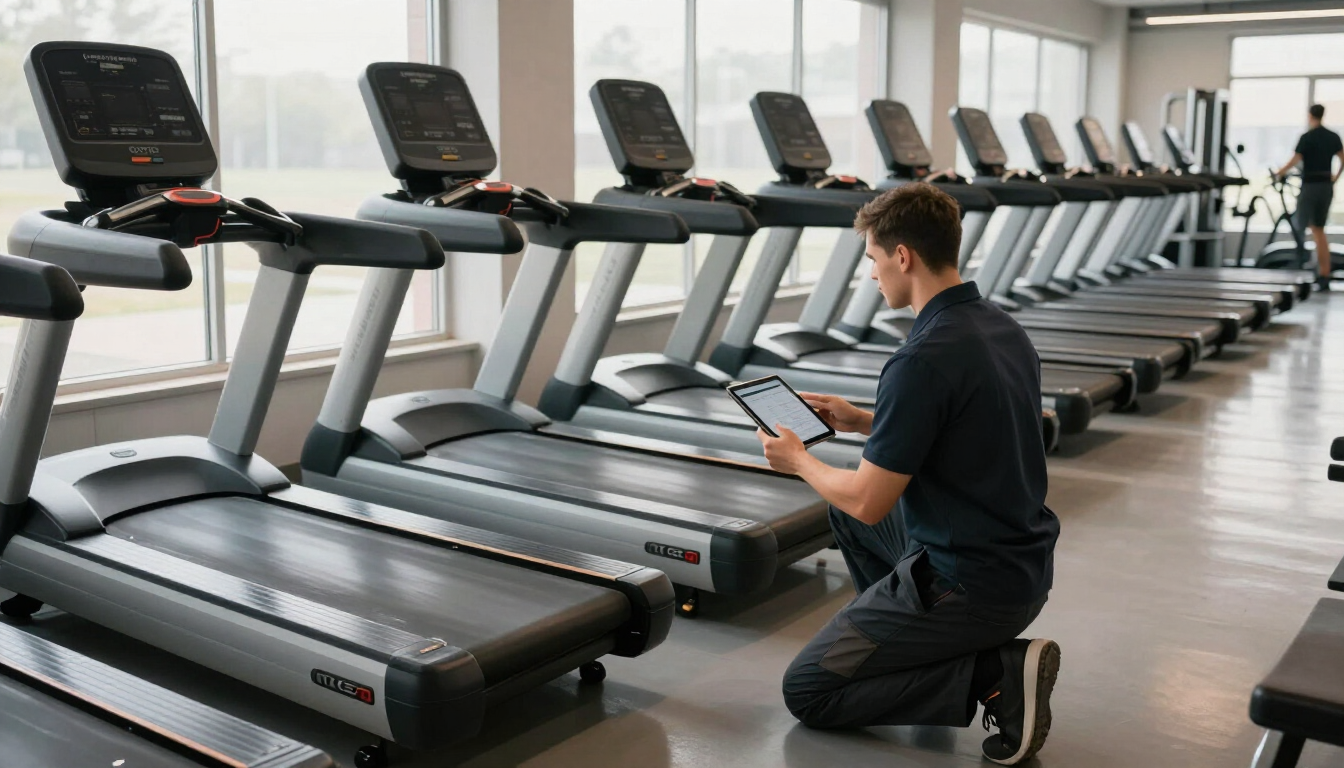


Reading the Warning Signs: How to Triage Commercial Cardio Equipment Repair Needs

A member tells your front desk that treadmill four is making a noise. Now what? Pulling a prime-time machine off the floor for something harmless costs you capacity, and leaving a real fault in service costs you a lot more than that.
You don't need to be a technician to sort this out. You need to be able to triage — to tell which commercial cardio equipment repair issues mean stop the machine immediately, which mean get it on the schedule this week, and which can ride until the next service visit.
The Three Buckets
Every symptom your staff reports lands in one of three categories. Train whoever works the floor to sort them this way.
| Bucket | What it means | Action |
|---|---|---|
| Stop now | Potential for injury or sudden failure under load | Power down, tag out, block access, call for service |
| This week | Functional but degrading; usable with caution or reduced settings | Log it, schedule service, monitor daily |
| Next visit | Cosmetic or minor; no safety or function impact | Add to the running list for the next PM visit |
When staff can't tell which bucket something belongs in, it goes in the first one. A machine out of service for two days costs less than the alternative.
Stop the Machine Now
These are non-negotiable. Power down, unplug where practical, tag it, and physically block access — a sign on the console is not enough on a busy floor.
- Any cable damage. Fraying, kinks, flat spots, or visible wire strands on any cable or strap. Cable systems are under tension and fail suddenly.
- Burning smell, smoke, or scorch marks. Anywhere on the machine, at any intensity.
- A treadmill belt that surges, hesitates, or changes speed on its own. An unexpected speed change under a running member is one of the most dangerous faults on a gym floor.
- Incline or resistance that moves without input or won't stop moving.
- Any tripped breaker or GFCI associated with the machine.
- A loose, cracked, or shifting frame member, weld, or mounting point.
- An emergency stop that doesn't stop the machine. Test these monthly.
- Loud metal-on-metal grinding or a sharp knock under load.
- Exposed wiring, a damaged power cord, or a console that's come loose from its mount.
Get It on the Schedule This Week
These won't hurt anyone today, but they get worse, and a small fault frequently damages something expensive if it runs long enough.
- A treadmill belt drifting off-center or visibly glazed and worn at the edges
- A persistent squeal, chirp, or rhythmic thump that changes with speed
- Incline or resistance that responds slowly, inconsistently, or with a lag
- A console that resets mid-workout, drops sensor readings, or loses connectivity
- An error code that clears on restart but keeps coming back
- Unusual heat coming off the motor housing after normal use
- A pedal, crank, arm, or seat carriage with noticeable play in it
- A stepper or climber that feels uneven side to side
Log the machine, the symptom, when it happens, and at what speed or resistance. That detail shortens diagnosis time considerably and often prevents a second trip.
What About Error Codes?
Error codes are manufacturer-specific and there's no universal decoder ring. What matters for triage is the category, not the number.
Codes generally point at one of a few areas: a motor or drive fault, a speed or position sensor fault, a controller or communication fault, an incline or resistance actuator fault, or a heart rate or accessory input fault.
Two practical rules. First, write the code down exactly as displayed and photograph the screen — "some error about the motor" isn't diagnostic information. Second, treat a code that recurs after a power cycle as a real fault, not a glitch. A machine that has to be reset daily is telling you something.
Clearing a code and putting the machine back on the floor is fine once. Doing it every morning for a month is how a sensor fault becomes a controller replacement.
Where the Line Is on In-House Work
Your staff can do meaningful upkeep. What they shouldn't do is anything involving stored energy, live current, or tension.
Safe and genuinely useful in-house: wiping down machines and consoles daily, clearing dust and debris from air intakes and around the base, checking that all shrouds, guards, and pins are present, inspecting cables and belts visually for wear, testing every emergency stop on a set schedule, keeping a written issue log, and tagging machines out of service properly.
Technician work, without exception: opening consoles, servicing motors or controllers, anything electrical, adjusting cables or cable tension, and servicing flywheels or brake systems. Beyond the injury risk, improper work on these systems can void your equipment warranty and leaves you without recourse when the same part fails again.
That's the dividing line for our equipment repairs work, and our post on signs it's time to call a professional covers more of the judgment calls.
Triage Is Damage Control. Prevention Is the Fix.
Everything above is reactive by definition — you're sorting problems that already exist. The floors we service that need the least emergency work are the ones on a maintenance schedule.
A preventative maintenance visit catches drive belt tension, tracking, calibration drift, and loose pivot hardware before any of it becomes a symptom a member reports. It also builds the service history that tells you which machines are genuinely worth continuing to repair.
When You Need a Technician on Your Floor
If something on your floor is in the "stop now" bucket, don't wait on it. If you're not sure which bucket it belongs in, that's a conversation worth having before a member finds out for you.
Email service@ecofitsolutions.com with the machine type, the symptom, and a photo of any error code, use our schedule a repair form, or start from our contact page. We service commercial cardio and strength equipment for gyms and studios across the St. Louis metro, and we'll tell you honestly whether a machine needs a repair, a maintenance visit, or a replacement plan.